The Neurons Keep Firing

Isolation, the Algorithm, and the Paranoid American Mind
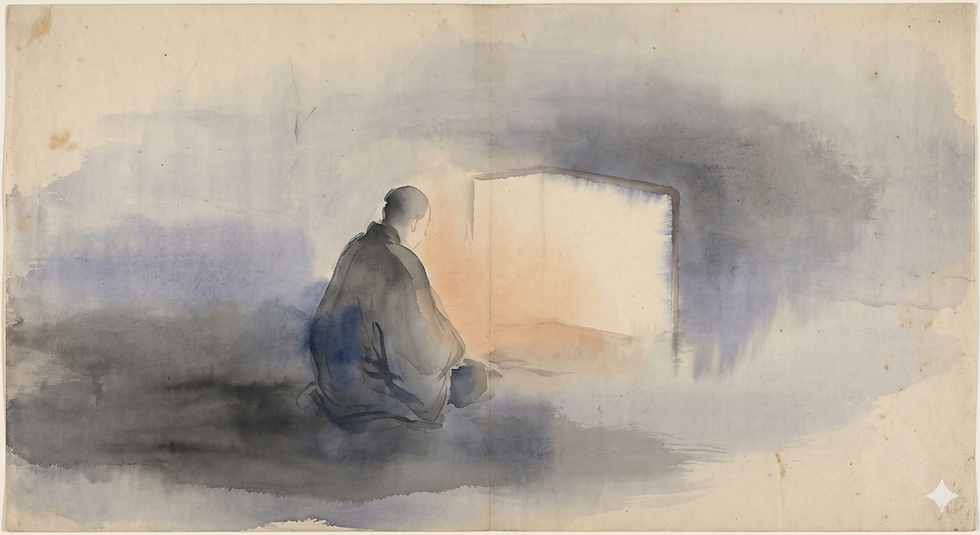
People subjected to prolonged sensory deprivation inevitably hallucinate and grow delusional. Our brains crave stimulation and once we remove the richness of the external world, the neurons keep firing, leading us into an alternative universe of buzzing confusion, perceptual warps, weird what-ifs, and, ultimately, paranoia.
— Jonathan Kellerman, Jigsaw
Kellerman wrote that passage about a single fictional woman who had walled herself into her apartment. He meant it clinically. But read it again slowly, and it stops being about one troubled character and becomes a diagnosis of a nation.
We are not, most of us, literally isolated. We are technically connected to hundreds or thousands of people at all times. We carry devices that can reach anyone on earth in seconds. We are never, by any measurable metric, alone. And yet something has gone profoundly wrong with the American mind, and the wreckage is visible everywhere: in the collapse of civic trust, in the epidemic of loneliness a recent Surgeon General felt compelled to name officially, in the flourishing of conspiracy theories so baroque that twenty years ago they would have been dismissed as the ravings of the odd man at the end of the bar. What happened?
The answer, I think, is that we have been given a very sophisticated simulation of connection in place of the real thing. And the brain, deprived of genuine human contact while receiving a steady signal that contact is occurring, does exactly what Kellerman describes. The neurons keep firing.
The Social Animal in the Frictionless Room
Humans are, in the most literal biological sense, social animals. Our nervous systems were shaped over hundreds of thousands of years to read other people: their microexpressions, their posture, the involuntary signals of fear or warmth or aggression that no screen can transmit. Co-presence is not a luxury. It is the substrate on which our perceptual and emotional life was built.
The smartphone does not provide co-presence. It provides a representation of a person, curated and performative, stripped of the biological richness that actual human contact delivers. Social media compounds this by replacing the mess of genuine relationship with metrics. You are not loved. You are liked. Approval becomes quantified and intermittent, which is precisely the operant conditioning schedule that produces the most compulsive behavior. It is, in engineering terms, a slot machine optimized for your particular vulnerability profile.
Screen time colonizes the hours that would otherwise produce what developmental psychologists call unstructured social play: the irreplaceable laboratory in which children learn to negotiate, lose gracefully, comfort each other, and tolerate the frustration of an actual other will that is not obligated to agree with them. Researcher Jonathan Haidt has documented the collapse in adolescent mental health that tracks with near-surgical precision to the mass adoption of the smartphone around 2012. The generation that grew up with screens as their primary social environment is, by every psychological measure, doing worse than any generation before it.
AI chatbots are the accelerant poured onto this already burning situation. A chatbot will never be bored by you, never prioritize someone else, never need anything from you. It is frictionless by design. And friction, the resistance of another actual will, is precisely where character forms. The irreducibly other human being who will frustrate and surprise you, who will be wrong sometimes and right about you in ways you did not expect: that person is real. The chatbot is a mirror that shows you only what keeps you engaged. Where the smartphone offered a degraded substitute for human contact, the AI companion offers a substitute so responsive and patient that the deficit it creates may not be felt until it is very deep.
Kellerman's observation cuts directly here. The brain deprived of the external world's richness does not go quiet. It generates. It pattern-matches on its own output. In a healthy social environment, other people correct the false positives. Your alarming interpretation of an event gets tested against what others perceived, and a negotiated shared reality emerges through that friction. Remove that correction mechanism and the pattern-matching runs unchecked. Every coincidence becomes evidence. Every authority denial becomes confirmation.
Before following that logic to its conclusions, one honest distinction is worth making. For the geographically isolated, the disabled, the teenager in a hostile family environment, social media and AI connection can be genuinely lifesaving rather than corrosive. The technology is not the problem. The problem is deployment: tools optimized for engagement rather than wellbeing, released at mass scale without meaningful consideration of their effect on the social fabric. Social atomization was already well underway before the smartphone existed. The automobile suburb, the death of the front porch, the replacement of the corner bar and the church social with the shopping mall: these were doing the work of isolation for decades. The smartphone did not create this problem. It found a population already primed and handed it a frictionless mirror to disappear into.
Why the Conspiracy Theories Got So Weird
Twenty years ago the man who believed the moon landing was faked was the odd one at the end of the bar. He had a handful of books, a few fellow travelers reachable only by mail, and the constant dampening effect of living in a world where most people he encountered in embodied daily life disagreed with him. Reality pushed back from every direction.
Now that same person has a YouTube channel, a Telegram group, a Substack, an AI chatbot that will explore his ideas with patient curiosity and never laugh at him, and an algorithm that will serve his content to everyone whose watch history suggests they might be receptive. The social cost of holding the belief has collapsed to near zero within his information environment, and the social reward, community, status, purpose, identity, has become enormous.
The algorithm did not design this through malice. It designed it through optimization. The engagement algorithm has one interest: keeping you on the platform. And it learned very quickly that the content most effective at sustaining engagement is content that triggers the threat-detection system. Outrage. Fear. The sense that dark forces are moving against you and only this community of knowing ones can see it.
What the algorithm effectively built was a machine for converting ordinary social anxiety into structured delusional thinking, then connecting people who share the same delusion so that they reinforce rather than correct each other. The isolated brain's weird what-ifs no longer died on contact with shared reality. They found a community of other isolated brains generating compatible weird what-ifs, and something that felt exactly like belonging rushed in to fill the void that real community had left.
This is why conspiracy communities are so resistant to evidence. They are not primarily epistemic communities. They are social ones. Abandon the theory and you lose the belonging, often the only belonging the person has. That is not a rational calculus anyone abandons because you showed them a fact-check.
Old Poisons, New Infrastructure
Buddhist teaching identifies three root causes of suffering: greed, anger, and ignorance. They are called poisons because, like toxins, they do not require intent to cause harm. They are structural conditions, not moral failures. And they have an older, more useful frame.
Aldous Huxley, in The Doors of Perception, proposed that ordinary human consciousness functions as a reducing valve: a filter that admits what the organism needs for survival and excludes nearly everything else. Greed is the valve optimized for acquisition, orienting relentlessly toward what sustains the self. Anger is the valve optimized for defense, rejecting what threatens it. Ignorance is what any such valve inevitably produces: a world shaped by the aperture of the filter, mistaken for the world entire. The Three Poisons are not sins. They are the biological implementation of the reducing valve, doing exactly what they were designed to do.
What the attention economy discovered is that these filters can be located from the outside and exploited. The algorithm does not introduce the Three Poisons. It finds the valve already installed and optimizes its aperture for maximum engagement. Greed: the platform harvests human cognitive bandwidth for profit, manufacturing desire for the next scroll, the next hit of validation, the next outrage, each engineered to be more compelling than actual life. Anger: the algorithmic preference for threat-content as the most reliable engagement driver, amplifying the defense-valve until every political opponent becomes an existential enemy. Ignorance: and here is the darkest turn. Not simple lack of information, but the construction of an alternative information environment so internally consistent that the person inside it is, by their own lights, more awake than everyone else. The reducing valve, optimized by machine learning, learns to mimic the feeling of the valve opening. The poison of ignorance wears the costume of enlightenment. That is its most lethal form.
It is worth noting that none of this is new. The mechanics of the unanchored mind were mapped in considerable detail long before the smartphone.
Zhiyi, the sixth-century Tiantai master whose Mohe Zhiguan, Clear Serenity, Quiet Insight, remains the most comprehensive phenomenology of meditative experience in the Buddhist tradition, devotes substantial attention to what happens to the practitioner whose mind loses its corrective anchor in present-moment awareness. His description is striking in its clinical precision: the unmoored mind generates vivid internal phenomena that the meditator mistakes for external reality. Visions, voices, experiences of special knowledge, paranoid ideation. Zhiyi does not treat these as supernatural. He treats them as predictable products of a mind that has lost contact with the shared world. That is Kellerman's neurological argument, written in sixth-century Chinese, fourteen centuries earlier.
Nichiren's Rissho Ankoku Ron, the Treatise on Establishing the Right Dharma for the Peace of the Land, makes a systems claim that maps almost directly onto the current situation. When a population's perceptual apparatus is captured by distorted teaching, social disintegration follows as a structural consequence, not a moral punishment. He names the specific downstream catastrophes: war, wealth inequality, and the collapse of civic order. An algorithm that systematically distorts the perceptual field of hundreds of millions of people is, in Nichiren's framework, precisely the kind of wrong dharma whose social consequences are not only predictable but inevitable.
Perhaps most precise is the concept of the tenshi ma, the devil of the heavenly realm, from the Tiantai and Nichiren framework of the four devils that obstruct practice. The tenshi ma is the force that produces experiences of transcendence and special knowledge that are actually forms of deeper entrenchment in delusion. It is the obstacle that feels like awakening. The person inside a conspiracy community who experiences the sudden clarity of finally seeing through the official narrative, who feels they have woken up while everyone around them remains asleep, is having a recognizable tenshi ma experience. What is new is not the experience but the infrastructure capable of delivering it at industrial scale.
The Buddhist principle of esho funi, the non-duality of self and environment, offers a final frame. Self and environment arise together and shape each other continuously. An algorithm that isolates millions of minds simultaneously degrades the shared perceptual commons on which everyone depends. The damage is not only personal. It corrupts the field in which all of us are practicing, whether we know we are practicing or not.
— — —
Buddhist practice is, at its root, a technology for restoring contact with what is actually present. Meditation does not add something. It removes the noise that prevents us from receiving the signal that was always there: the texture of breath, the weight of the body, the simple fact of being alive in a shared world with other living beings. Daimoku, the chanting meditation practice at the center of the Nichiren tradition, does the same work through sound and resonance rather than silence.
What all genuine practice shares is friction: the encounter with what is actually here rather than the encounter with our preferred representation of it. The cushion does not optimize for engagement. It offers only what is real, which is sometimes uncomfortable and always sufficient.
Kellerman's Martha walled herself in, and the walls fed on themselves. The neurons kept firing in the absence of a world to fire at. The technology we have built at civilizational scale has given millions of people very beautiful, very stimulating walls, and called it connection.
The neurons are still firing. The question is what we choose to put in front of them.



Comments