The Deathless Was Never a Psychedelic

Updated: Sep 1
A Dialogue on Psychedelics, the Jhanas, and the State Mistaken for the Goal

A persistent fallacy of modernity is that every problem has a solution, that if we work at it hard enough and bring the right technology to bear, anything at all can be fixed. Need to lose weight? Take a pill. Carrying therapy-resistant trauma? Take a trip. Peptide cocktails of dubious origin are all the rage, never mind that not a single longitudinal study stands behind them. Longevity and death are on the table too: inject yourself with “young blood,” and I defy anyone to tell me this does not make Bram Stoker look prescient. The list runs on, and at the far end of it, serious-minded scientists and meditators are now working toward an enlightenment pill. (Sadly.) Life hacks are the big thing now. Whatever the problem, there must be something quick you can take, some tech to find, some hack to run, some way to bypass the effort. Most of this is recent, and most of it is, at best, merely foolish.
The resurgence of interest in the therapeutic capabilities of psychedelics has caused some to wonder whether the religious impulse itself was first kindled by the visions that psychoactive molecules produce in the mind, whether the very notion of a beyond, of a hidden dimension, of an afterlife, arrived as the effect of a plant-based chemical on the brain. The scholars who have argued that psychedelics played a foundational role in religion all work one side of the map. Wasson and Ruck on the Eleusinian mysteries, Allegro on early Christianity, Muraresku on the Greco-Christian world of late antiquity, Hofmann supplying the chemistry. Every one of them is writing about the West. Not one is writing about the Buddha. Given that the Buddha is regarded as one of the world’s great consciousness-explorers, this seemed odd to me, and a huge miss. Why leave him out of the conversation?
The question grew less simple the longer I pursued it. One boundary belongs at the outset. The inquiry concerns Buddhism specifically, and so it brackets the entheogenic traditions of the Americas and elsewhere, which are genuine and ancient but lie outside any line of transmission to the Buddhist world, and which can therefore neither support nor refute a claim about this tradition. What unfolded was a conversation, and I have chosen to keep it in that shape. The mondo, the dialogue of question and answer, is among the oldest containers we have for working a hard matter. Nichiren favored it. Several of his most important letters are staged as exchanges between two people sitting together, one raising the objection a reasonable person would raise, the other turning it. The form has a virtue that flat exposition lacks: it refuses to let the conclusion arrive before the objections have had their say. What follows was built that way, each piece of the answer pried loose by a question, and the order of discovery is the order of the argument. The exchange has been edited for the page and its sources named, but the spine is unchanged.
I. The Absent Name
Question. These scholars make a real case, and the Western record seems to bear them out, from Eleusis to the soma of the Vedas. Yet I have never read anything connecting any of it to the Buddha or to Buddhism. Is that a gap in my reading, or is the connection simply not there. Has anyone done the research.
Answer. You have not missed much, and the roster of those scholars proves it. The entheogen-and-religion field is built almost entirely on Indo-European and Western material. Wasson and Ruck on Vedic soma and Eleusis, Allegro on early Christianity, Muraresku on the Greco-Christian mysteries. Buddhism is absent from that lineage not because the scholars overlooked it but because it is the hard case for the thesis. Still, research does exist, and it sorts cleanly into three strands of very different strength.
The first strand is early Buddhism, and here there is essentially nothing, for a structural reason. No credible scholarship connects an entheogen to the Buddha of the early discourses or to early Theravada, and the obstacle is doctrinal. The fifth precept, surameraya-majja-pamadatthana veramani, has the early texts condemning intoxicants almost without exception, and the path itself is built on appamada, non-heedlessness, which is the precise opposite of an intoxicated state. There is a philological debate worth knowing, since the terms name fermented and distilled liquors of the period and the operative concern is the clouding of the mind rather than the substance as such, and that narrow ambiguity is the only doorway any Buddhist version of the argument can try to squeeze through.
The second strand is Vajrayana, and here a real but contested literature lives. The peer-reviewed anchor is Scott Hajicek-Dobberstein’s 1995 paper in the Journal of Ethnopharmacology, which reads the legendary biographies of the eighty-four mahasiddhas, the siddha Karnaripa above all, as veiling references to the fly-agaric mushroom, Amanita muscaria, behind a screen of symbols. The book-length treatment is Mike Crowley’s Secret Drugs of Buddhism, which argues that amrita, the sacramental nectar of the Vajrayana, descended from Vedic soma and was originally a potent entheogen, even though the amrita of modern ceremonies is pharmacologically inert. Both are ingenious, and both rest heavily on decoding rather than on any text that plainly says a practitioner consumed a named substance.
The third strand is the modern American convergence, and it is the most solid scholarship of the three while being about an entirely different question. Douglas Osto’s Altered States, from Columbia University Press in 2016, documents how Buddhism and psychedelic spirituality met and shaped each other in twentieth-century America. One of its chapters is built directly on the fifth precept and on what practitioners describe as graduating from psychedelics. That is a sociological account of the present, not evidence about the tradition’s origins. The pattern across all three strands is the one worth holding: the case fits Hinduism, where soma is openly scriptural, and it fits the mystery cults, where secrecy was the point, and it resists Buddhism precisely because the Buddhist method is the systematic training of attention rather than its chemical disruption.
II. The Borrowed Word and the Borrowing Stream
Question. Two objections occur to me. First, the Rig Veda is a Hindu text. Building a Buddhist case on soma seems overly syncretic, with no real justification for the leap. Second, the serious evidence comes through Vajrayana, which is a late stream and itself heavily syncretic, fused with Tibetan and shamanic culture. One could argue that Vajrayana is Buddhist-adjacent rather than Buddhism proper.
Answer. Both are sound, and they turn out to be the same objection wearing two costumes. Take the soma point first. The flaw is more specific than the text being Hindu. The argument runs on lexical continuity disguised as material continuity. Amrita, the deathless, is a pan-Indian religious word, and yes it sits near soma in the Rig Veda and yes it returns as the Vajrayana nectar, but the survival of a word proves that the word traveled, not that a psychoactive substance traveled inside it. The chronology makes it worse. By the Buddha’s era the actual soma plant, whatever it was, had very likely already become ritually symbolic or substituted within Brahmanism itself, which is why its botanical identity was lost. Importing it as a Buddhist substrate is exactly the unjustified leap you named.
On Vajrayana, the evidence for your reading is firmer than a hunch, and it comes from the most rigorous philology in the field. Alexis Sanderson has shown that the Buddhist Yogini tantras borrow extensively from Saiva and Sakta sources, in some cases copying whole passages, with the predominant direction of borrowing running from Saivism into Buddhism. His reconstruction of the Cakrasamvara material describes a Buddhist tantra assembled in ninth-century eastern India out of Saiva, Sakta, and Buddhist sources by a process of montage. Stack the Tibetan absorption of indigenous and shamanic cult on top of that Indian layer, and the stratum where the entheogen evidence concentrates is the latest, most borrowed, most ritually transgressive layer in the whole tradition. The evidence is densest exactly where Buddhism is least itself.
Here is where I would enter one piece of pushback, because the move has a cost. Pure Buddhism is a slippery baseline, and pressing it too hard turns on you. The early canon is itself the redacted product of one surviving school, and the picture of a pristine original behind it owes a good deal to nineteenth-century European and reformist construction. More to the point, syncretism is not Vajrayana’s special vice, it is universal. Chan absorbed Daoist vocabulary, Pure Land absorbed a devotional structure, East Asian Buddhism absorbed Confucian social forms, and the earliest layer absorbed the pan-Indian yogic substrate wholesale. A criterion that exiles Vajrayana for borrowing eventually exiles everything except an original that no one can produce, because that second step smuggles in a purity standard that no tradition survives. The cleaner formulation is not that Vajrayana fails to be Buddhism but that it cannot stand in for Buddhism. Granting the entheogen evidence in full, it licenses a claim about one late syncretic stream and nothing about the founder or the foundational method.
Which is the unifying diagnosis, and it is why your two objections are one. Both catch the same fallacy, an illegitimate transfer across a boundary, bridged by a shared label. The soma move crosses the Vedic-to-Buddhist line on the word amrita. The Vajrayana move crosses the early-to-late line on the word Buddhism. In each case continuity of vocabulary is doing the work that only continuity of substance and practice could honestly do. And this strengthens rather than weakens the verdict, since the entheogen case gets traction only at the syncretic margins and never reaches the precept-bound, attention-training core, which is itself a substantive fact about what Buddhism distinctively is.
III. The Test of Attestation
Question. Here is a principle I would apply generally. Any argument that requires elaborate interpretive translation, the move that says what this really means is such and such, is suspect unless it can be tied to an actual sutta, sutra, or reliable commentary.
Answer. That is the right default, and it is the same standard you already enforce on your own citations, physical text or nothing, never confabulation. The principle is a demand for attestation over decoding, and it places the burden where it belongs, on the one making the positive claim. It bites hard here because the entheogen thesis is almost nothing but decoding. The pancake balanced on a needle really is the mushroom, the parasol really is the cap, the sweating deity really encodes the drug effect. At no point does a text say that a practitioner consumed a named psychoactive substance and describe its effect.
Worse, the thesis carries a built-in defense against its own lack of evidence, and that defense is the tell. The case concedes that the ingredient was unnamed and concealed behind symbols, in keeping with vows of secrecy, which converts the absence of attestation into confirmation: the texts do not mention the substance because the substance was the secret. A hypothesis that treats silence as proof is unfalsifiable, and your alarm is detecting exactly that structure.
One refinement keeps the principle from overreaching, and it ends up reinforcing your point. Tantra genuinely is encoded by design. The tradition itself speaks of sandhyabhasa, the twilight or intentional language, and insists its texts carry levels that only oral commentary unlocks. So you cannot ban interpretive translation wholesale in this genre without contradicting the genre’s own self-description. The decisive move is the second half of your criterion, the part about reliable commentary. Where the Indian and Tibetan commentators actually gloss amrita, they read it yogically and symbolically, as bodhicitta, as the nectar of meditative bliss, as the union of method and wisdom visualized and drunk in practice. They do not read it pharmacologically. So the entheogen theorists are not recovering the tradition’s hidden meaning, they are overriding the tradition’s own interpreters and substituting a botanical reading the commentaries never offer. Applied properly, your standard does not merely note the missing sutra, it shows that the texts which do exist point the other way.
The honest caveat sits on the opposite side. Silence is not disproof. Esoteric practice can be real and under-recorded, and no canonical passage saying so cannot by itself establish that something never happened. But that only returns the claim to unproven, and unproven is where it stays once the disqualifiers are added up: decoding-dependent, secrecy-sealed, contrary to the explicit precept, and contrary to the commentarial gloss. That is a stack, not a single gap. And the contrast case proves the test is fair. The Vedic material passes it. Soma is not hidden. The ninth book of the Rig Veda is given over to it, and the famous verse declares, without a particle of concealment, we have drunk the soma, we have become immortal, we have gone to the light, we have found the gods. No decoding, no twilight language, no vow of secrecy. That open attestation is why the entheogen argument is respectable for Hinduism and collapses for Buddhism.
IV. The Open Road
Question. No one seems to take up the obvious vector. The Silk Road carried goods, services, ideas, and surely drugs. If the Greeks were experimenting with the pharmakon, those ideas would have traveled the same routes east. Why is this not explored.
Answer. The premise is unimpeachable, and the complaint is fair, since the entheogen writers lean on it surprisingly little. There is even hard material evidence for psychoactive ritual right on the corridor. At the Jirzankal cemetery in the Pamirs, chemical analysis of ten funerary braziers showed that high-potency cannabis was burned in mortuary ceremonies around five hundred years before the common era, and the lead archaeobotanist framed it precisely as knowledge of cannabis smoking spreading along Silk Road exchange routes. So your hunch that drugs rode the same wagon-wheel spokes as silk and glass is demonstrated, at least for one substance.
The trouble is that the Silk Road argument is a diffusion argument, and diffusion is exactly the reasoning your own attestation principle was built to discipline. The classic error is to treat the channel as the cargo. Contact is necessary but not sufficient. The capacity of an idea to travel is not evidence that it arrived, was received, and was adopted at the far end. Three complications then turn the point from suggestive to actively unfriendly to the thesis.
First, the cannabis evidence is the wrong actors and the wrong substance. The Jirzankal braziers belong to a Sogdian or Scythian milieu, mobile steppe peoples in the orbit of Zoroastrianism, which is to say funerary smoke among Iranian nomads, not sangha practice, and it is cannabis, not the Eleusinian draught. It shows psychoactive ritual flourished in the corridor. It shows nothing about Buddhist adoption, and if anything the precept-bound order defined itself against that very register.
Second, the documented direction of contemplative influence at the Greek and Buddhist contact zone runs opposite to your arrow. Christopher Beckwith’s Greek Buddha makes the case that Pyrrho, who traveled with Alexander into Central Asia and India and encountered early Buddhist teachers, carried a Buddhist-shaped skepticism back to Greece, tracing a Western philosophical lineage to Gandhara. The thesis is contested and I hold it loosely, but it is the best-attested intellectual transfer at exactly the junction you invoke, and it inverts the premise. The Greeks may have imported their version of dispassion from the Buddhists rather than exporting the pharmakon to them.
Third, and decisively, the Hellenistic channel was not narrow. Greco-Bactria, the Indo-Greek kingdoms, the dialogue of King Milinda, the Buddha image itself born from Gandharan sculpture: the corridor demonstrably carried high-volume traffic in art, philosophy, and kingship straight into Buddhism during the very centuries it was spreading along these routes. The pipe was wide open and richly documented, and the entheogen still does not appear in the Buddhist record that came through it. That is not silence from lack of contact. It is silence despite maximal contact, alongside an explicit rule against intoxication. When a tradition sits astride the most cosmopolitan exchange network on earth, absorbs nearly everything else moving across it, is demonstrably exposed to Scythian cannabis and Iranian rite and Greek pharmakon, and the one thing it codifies in response is a precept against heedlessness, the absence stops looking accidental and starts looking like a filter doing its job. The Silk Road, traced honestly, documents the filter rather than the smuggling.
V. The Spine
Question. Now it grows interesting. One might read the Rig Veda’s soma verse, we have drunk the soma, we have become immortal, we have gone to the light, we have found the gods, as a charter for the chemical path. But set it against the Buddha’s own life. He rejected all of that, first by mastering it, and in mastering it showing that it could not end suffering or bring awakening. He woke through meditation. The fifth precept becomes a warning against the shortcut. And shortcuts do not work.
Answer. The reading is right, and it is right for a reason stronger than the one stated. The mastery-then-rejection structure is not a gloss on the Buddha’s life, it is the explicit architecture of the discourse on the noble search. Before the awakening he studied under Alara Kalama and Uddaka Ramaputta and attained what they taught, the sphere of nothingness and then the sphere of neither-perception-nor-non-perception, the ceiling of the consciousness-altering technology of his world. He reached what his teachers had reached, they offered to make him their equal, and he walked away with a stated reason: these attainments do not lead to disenchantment, to dispassion, to cessation, to awakening, but only to rebirth in those same refined spheres. He then drove the body to the opposite extreme in years of austerity no one surpassed, and rejected that too, recovering the middle way only after Sujata’s milk-rice restored him. The pattern is canonical and it is doubled. He exhausted the most refined alteration of mind and the most severe alteration of body and found both to be dead ends.
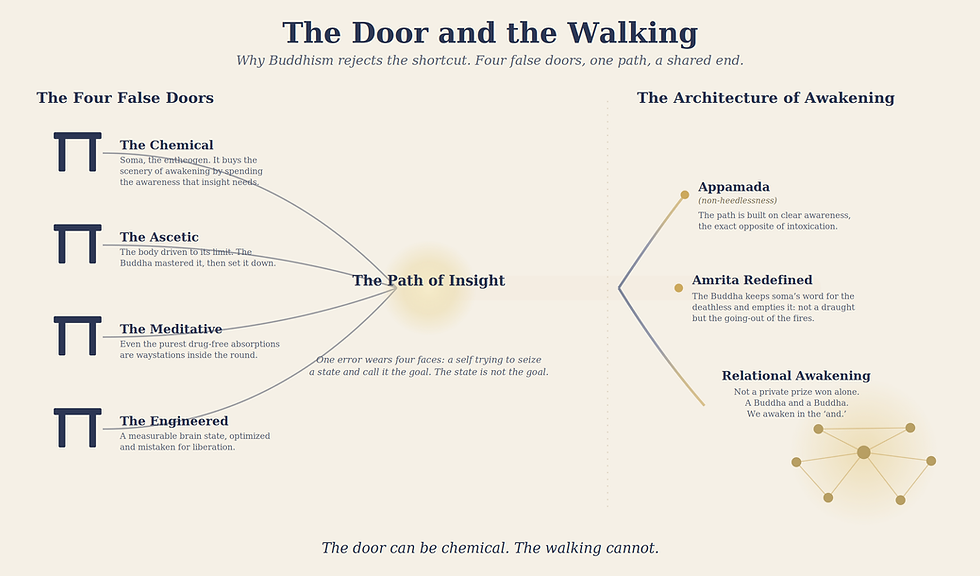
That is why the rejection cuts deeper than a warning about a failed shortcut. The formless attainments were not intoxicants. They were the purest, most disciplined, most sober altered states a human being of that age could produce, and he set them down all the same. The target of his refutation was never the chemistry. It was the equation itself, the assumption that some special state, however sublime, is the same thing as liberation. Chemical, ascetic, meditative: three doors, one error.
Here is the one correction, and it bears on your own standard. The Buddha did not master and reject soma. There is no account of him drinking it or any intoxicant and finding it wanting, so first by mastering it cannot mean the substance without sliding from attestation into extrapolation. What he mastered and rejected were the states, and this is where the reading becomes precise. Read the Rig Veda line again as a destination report: immortality, the light, the company of the gods. In Buddhist cosmological terms that is not a drug trip, it is a description of the brahma and deva realms, which are exactly what the formless attainments deliver as rebirth. The soma-drinker’s reported arrival and the meditator’s formless attainment share one address. The Buddha’s signature move, the thing that divides him from the whole Vedic world, was to demote that address from the goal to a still-conditioned, still-impermanent waystation inside the round. He did not need to drink soma to refute it. He refuted its promise from the inside, by attaining the meditative equal of everything it advertised and reporting back that the advertisement was false.
There is a lexical detail that closes the arc. The word the Rig Veda gives soma is amrita, the deathless, and that is the very word, as amata in the early language, that the Buddha keeps and repurposes. Across the discourses amata becomes a name for nibbana, the doors to the deathless are said to be open, but the deathless is no longer a draught you swallow or a heaven you reach. It is redefined as the extinction of craving, the going-out of the fires, the unborn-undying that is not a place or a substance at all. He performed a semantic expropriation. He took soma’s own keyword, non-death, emptied it of nectar and brahma-world, and refilled it with cessation. The entheogen thesis needed that single word amrita to ferry it from the Veda into Buddhism. The Buddhist record shows the founder seizing the same word and ferrying it the opposite way, away from the substance entirely.
So the precept’s logic is sharper than shortcuts do not work, which still concedes that the shortcut points at the right destination. The intoxicant points at a counterfeit of the destination. It can reproduce the scenery of awakening, the bliss, the dissolution of the self-sense, the luminosity, while suppressing the one faculty, penetrative awareness, that converts a state into insight. Pamada is not a slower road to appamada, it is motion in the contrary direction. The formless absorptions keep the awareness and still fall short of liberation. The intoxicant spends the awareness to buy the scenery, which is why it falls shorter than even the sublime dead ends he had already refused. The modern echo is documented. The pattern Osto found among American convert Buddhists, of practitioners describing the substance as a door-opener and never a vehicle, is the same structure surfacing twenty-five centuries later in people who arrived at it by experiment rather than by scripture. The door and the walking are different acts, and only one of them can be outsourced.
VI. Whether the Great Vehicle Came from the West
Question. A hypothesis, offered as nothing more. Could the Theravada and Mahayana split have been shaped by Western philosophies and religions. The ideal of self-sacrifice for the good of others, the bodhisattva who forgoes liberation for the sake of all beings, does not seem to be present in Theravada.
Answer. The instinct deserves to be taken seriously before it is corrected. The chronology and geography are on your side. The earliest Mahayana sutras crystallize roughly between the first century before the common era and the first century after, and Gandhara and the Kushan realm are a principal cradle. The oldest Buddhist manuscripts we possess at all, the Gandhari birch-bark scrolls, come from exactly that Indo-Greek and Iranian contact zone. A hypothesis that looks for outside pressure at the moment of the split is not crankery.
The correction is to the premise rather than the instinct. Self-sacrifice for others is not absent from Theravada, it is canonical and central. The Jataka tales are wall-to-wall radical altruism: Vessantara giving away his children, the hare in the fire offering its own body to feed a beggar, the recurring gift of the body. There is a canonical text devoted to the bodhisatta’s perfection of exactly these virtues across past lives, and the divine abidings of loving-kindness and compassion are bedrock early teaching. What Mahayana did was not invent the altruism, it universalized the vocation. Theravada reserves the bodhisatta path for the rare being destined to become a fully awakened Buddha and points everyone else toward arhatship. Mahayana took that exceptional career and made it the recommended aspiration for all, then elevated the bodhisattva above the arhat. The shift is one of scope and ranking, not the importing of a compassion the tradition lacked.
That matters because the origins scholarship runs almost entirely inward. Paul Harrison’s study of the earliest sutras translated into Chinese showed early Mahayana to be overwhelmingly a monastic movement, which killed the older lay-origins theory. Harrison and Reginald Ray then advanced the forest-renunciant hypothesis, and Jan Nattier found textual support for it, as did Daniel Boucher in his work on a sutra where the gift of the body sits at the center of the bodhisattva path. Alongside that runs Gregory Schopen’s cult-of-the-book thesis, with David Drewes pushing back in turn. The point for you is that the entire live debate is internal: forest ascetics, preacher networks, book veneration, visionary meditation. No serious current thesis derives the bodhisattva ideal from Greek or Western ethics.
Where outside influence is real and respectable, it shows up in two narrower places, and they are more Iranian than Greek. The Buddha image itself emerges from Gandharan sculpture under Hellenistic hands, which is uncontested. And the savior-and-light cults, Amitabha as infinite light and Maitreya as future redeemer, are where scholars have floated Iranian and Zoroastrian parallels, though that remains debated and minority. So your nose for the contact zone is not wrong, it is that the traffic one can document runs through iconography and certain devotional cults, not through the ethic of self-sacrifice. And having just used the reversal of Pyrrho’s arrow, the discipline cuts both ways. The self-sacrifice motif is over-determined by indigenous sources, so positing a Western origin where a rich domestic one already saturates the record is the diffusionist temptation wearing a new hat. The fertile version of your hypothesis is the narrow, Iranian-flavored one about savior figures and light, not the broad one about altruism.
VII. Whether the Sutras Are Trip Reports
Question. One can hardly read the Flower Garland or the Lotus as anything but psychedelic cosmic dramas. Surely that is worth a smile, and perhaps a bit more than a smile.
Answer. It is, and it is not only a smile. Yes, these texts read like phantasmagoria. Sudhana entering Maitreya’s tower and finding infinite interpenetrating worlds inside it, the jeweled net in which each gem reflects all the others, the Buddha in the Lotus sending a ray from between his brows that lights up thousands of world-systems, the jeweled stupa erupting from the earth and the whole assembly lifted into space. Hand those passages to a naive reader and ask for the genre, and trip report is a defensible answer.
But the tradition’s own account of where the imagery comes from is samadhi, and it says so structurally. These sutras characteristically open with the Buddha or a bodhisattva entering a named meditative absorption, and the cosmic vision unfolds out of that state as its content. The sutra on the samadhi of being face to face with the present buddhas is, in effect, a manual for generating vivid visions of buddhas through concentration, and Paul Harrison reads it as a window onto the visionary and meditative milieu that produced this literature. So the most psychedelic-looking body of writing in all of Buddhism is, by its own framing and by the best scholarly account, the output of trained absorption composed by ascetics. The phenomenology is fully hallucinatory and the pharmacology is zero. That is the strongest demonstration the whole inquiry could ask for. The cushion produces the entire cosmic payload unassisted, which means the cosmic payload is not evidence of a drug, it is evidence that you do not need one.
VIII. The Refined States That Are Still Within the Round
Question. And the Four Dhyanas. They are altered states, analogous in their way to what a psychedelic offers. The Buddha and the great meditation masters warned that the dhyanas are still within the frame of samsara.
Answer. The reading is right with one precision that makes it sharper. Keep the two tiers distinct. The four meditative absorptions are the ones the Buddha affirmed and built into the path, for right concentration in the eightfold path is defined as the four jhanas. The four formless attainments are the ones his teachers taught and he set down. So the teaching is not that the jhanas are rejected, it is that no absorption, however refined, is itself the goal. The jhanas are mundane attainments that on their own yield only rebirth in the matching cosmological tier, and they become liberating only when the concentrated mind is turned to insight. State alone is a luxurious cul-de-sac. State joined to penetrative seeing is the path.
That cosmological mapping is the elegant hinge back to soma. The meditative attainment and the rebirth destination share an address. The form and formless absorptions open onto the form and formless heavens, and soma’s advertised arrival, immortality and light and the company of the gods, is the same address read off the Vedic side. The jhana attainer, the formless-realm-bound meditator, and the soma drinker are all reporting from the same coordinates, and the Buddha’s move was to stamp every one of those coordinates as still inside the round.
The masters’ warning you invoke is well attested and cross-traditional. The great Theravada manual catalogs ten imperfections of insight, the luminous light, the rapture, the bliss, the tranquility, and the rest, the spectacular byproducts of deepening practice that meditators mistake for awakening, with attachment to them named as the actual trap. Zen gives the same warning another name, makyo, the visions arising in seated meditation that the practitioner is told to note and walk past. Both are explicit guardrails saying the luminous state is scenery, not arrival. That is the precept’s logic delivered from the meditative side rather than the chemical one. And it preserves the hierarchy intact. The formless attainments keep the awareness and still fall short, the form jhanas keep and refine the awareness and are retained as a limb of the path yet are not the goal alone, and the intoxicant spends the very awareness the others develop. A psychedelic can paint the scenery of jhana convincingly. What it cannot do is the one thing jhana exists to make possible, which is to hold that scenery in a mind clear enough to see through it.
IX. The Hack
Question. A last observation. There are people now teaching the Four Dhyanas as a method for arriving at these altered states, treating the states as ends in themselves. Life hacks.
Answer. This is where the whole argument lands, because the error has now shed even the drug. The clearest case is a startup that runs retreats built around reaching the jhanas, marketing them with results-oriented teaching and technology, promising joy on tap and jhana in days rather than decades, with neurofeedback meant to make the states arrive more deterministically and testimonials from engineers at the major laboratories. Strip away the branding and what remains is the precise error the inquiry has been chasing, now with the substance subtracted and the tradition’s own approved method dropped into its place.
That substitution is what makes it the cleanest specimen yet. The argument kept localizing the error in one spot, the equation of a special state with liberation, and we watched it prove substrate-independent, the same mistake whether the door was soma, austerity, or the formless spheres. The jhana hack commits it with nothing left to blame. No Vedic import, no Tibetan syncretism, no Greek pharmakon, no intoxicant at all. It uses the endogenous, orthodox, drug-free technique we had just praised as proof you do not need a substance, and it lands on the attachment to the refined state that the manuals name as the trap, and on the luminous scenery Zen tells you to walk past. The masters’ warning was never aimed at the chemistry. It was aimed at the relationship to the state, and here is someone with perfectly pure access reproducing the error in full.
Which settles the last open question. There was always a complacent refuge available: meditation is the pure route, so whatever we said about soma cannot touch it. The hack dissolves that refuge by demonstrating that pure access joined to the wrong relationship yields the same dead end as impure access. Purity of access was never the variable. The fifth precept, read all the way down, was never fundamentally about what you ingest. It was about heedlessness against the cultivation of liberating awareness, and one can be entirely sober, entirely absorbed, and still heedless in the only sense that matters, if one has made the state terminal.
The fair version of the counterpoint keeps this from becoming a blanket charge. Reviving skill in the jhanas is not the error and is arguably a corrective, since the dry-insight movements had let the concentration limb wither, and the better teachers embed the states inside the path toward insight. The error is the decoupling, the state pursued and sold as the product, severed from the seeing that is its only justification. The life-hack framing is the tell, because a hack optimizes for the reward and discards the labor, and in the tradition the jhana’s entire worth is as the steady platform for the labor that comes after. Harvest the calm that was meant to be the place you finally look from, never look, and the platform has quietly become the view. The measurement layer pours accelerant on exactly that, since a measurable brain state is also a metric, a metric invites optimization, and optimization invites mistaking the metric for the goal, which is an old law arriving in the meditation hall.
The part that should make us smile is that the hack refutes itself from the inside, empirically, with no one preaching at it. The reporting from these retreats keeps circling the same discovery. A longtime meditator described the jhanas as cool toys that you tend to put away after an initial period of obsession, and the writers note the surprise that finding the bliss button does not make people want to keep pressing it. Even the founder’s own telling concedes that the bliss turned out to lie on the far side of cultivating love and giving it away, which is to say the divine abidings and self-transcendence, which is to say the path the hack was trying to skip. The waystation keeps insisting that it is a waystation.
X. What Awakening Is
Question. The dialogue has said, at great length, what awakening is not. Not the chemical state, not the ascetic, not the jhanic, not the engineered, not a private interior available on demand. The Lotus Sutra offers a positive claim that may answer what the negations leave open. It reveals that the four assemblies, monks and nuns and laymen and laywomen, and even the voice-hearers and the solitary realizers, are in truth all bodhisattvas, that the Buddhas teach only bodhisattvas because there is no one else to teach, and that we are already what we are becoming. The implication seems relational, that our own awakening happens only in relation to the awakening of others. Is that reading sound, and does it answer what the negations could not.
Answer. The reading is sound, and it is the positive form of everything the dialogue could until now state only by negation. Render the architecture first. The Lotus opens the three vehicles and reveals one, the single vehicle, the ekayana, by the device the Tiantai tradition calls opening and merging. The voice-hearers and the solitary realizers, the very ones the earlier teachings had written off as scorched seed, receive their predictions of buddhahood, Sariputra first, then the great disciples, and in time even Devadatta and the dragon girl. The two vehicles attaining buddhahood is the scandal the provisional teachings could not permit, and the Lotus makes it the center. The one great reason the Buddhas appear at all is to open, to show, to awaken, and to lead beings into the wisdom of a Buddha. So every vehicle was always the one vehicle, every hearer was always a bodhisattva, and the Buddhas teach nothing but bodhisattvas because there was never anyone else in the room.
Now the turn that answers the negations. The dialogue established, disqualifier by disqualifier, what awakening is not. The coda could gesture at the positive only by saying, open the hand. The Lotus names what the open hand was holding. Awakening is not a possession because it is not singular. The phrase Yui Butsu Yo Butsu does not say only a Buddha. It says a Buddha and a Buddha. The grammar itself refuses the solitary. The true aspect of all things is fathomed in the and, in the between, never alone.
This explains the original error more deeply than impermanence did. The fault in the bliss-button was not only that the state does not last. It was solipsism, the attempt to procure awakening as a private experience, generated alone, for oneself. A self-arising awakening would be an awakening possessed of svabhava, of independent own-being, and emptiness denies exactly that. So the emptiness of awakening is its relationality. A thing with no isolated nature cannot awaken in isolation, because it has no isolated nature with which to do so. The provisional, in the threefold truth, is the actual web of relation in which any awakening occurs, and the middle holds emptiness and relation together without letting either collapse. In the vocabulary of the consciousness studies this inquiry has been circling, this is the enactive thesis worn as a path: mind is not an interior privately held but is enacted between, embodied and embedded. Our awakening in relation to the awakening of others is dependent origination read forward into liberation.
And this dissolves the hierarchy that an earlier exchange left standing. The Lotus does not crown the bodhisattva as a higher saint above the arhat. It abolishes the ranking. All are bodhisattvas, the gradations were skillful means, the three are opened into the one. So the relational reading is the opposite of the Great Vehicle as superior. It is the Great Vehicle as universal, the hierarchy ended rather than topped. The very thing a certain training sells as the bodhisattva’s superiority turns out, read through the one vehicle, to be the end of superiority.
One honesty is owed here, the same the dialogue demanded of the entheogen decoders, since the coin should look the same on both faces. At first-order reading, Yui Butsu Yo Butsu in the chapter on skillful means marks the sheer profundity of the true aspect of all things, the truth so deep that only buddhahood, a Buddha together with a Buddha, can exhaust it, and it sits just before the ten suchnesses. The relational soteriology drawn out here is a deepening of that line, crystallized most famously by Dogen, who took Yuibutsu Yobutsu as the title of a fascicle and read the and as the mutual, between-buddhas character of realization. So this is amplification, well-precedented and, I judge, faithful, rather than the plain surface of the text, and it is owned as the harvest it is. The one happy difference from the decoders is that here the commentarial tradition stands with the reading rather than against it.
Coda: The Opening Hand
That is the dialogue’s final form. We cannot convert the scenery into the destination, not with soma, not with austerity, not with the formless spheres, and not with an electrode array and a forty-hour retreat, because the state is conditioned and impermanent and will not hold still as a possession. The acquisitive frame, the I attained the fourth jhana, quietly assumes a permanence the state cannot bear. The moment we stand up from the cushion entropy resumes and the returning begins again, and this is not a failure of the practice but its nature. Sudden and gradual are not opposites, each contains the other, and even what arrives suddenly is impermanent, so the work is never arrival at a place we can keep but a continuous returning.
But impermanence was only half of why the doors were false. The four of them, the chemical, the ascetic, the jhanic, the engineered, share a single hidden shape, and it is not impatience. It is solitude. Each is a self trying to secure its own awakening, alone, generated within one skull and banked for one owner. The Lotus answers that the attempt is incoherent at the root, because there is no awakening that is only mine to have. A Buddha and a Buddha. We awaken, if we awaken, in the and, as bodhisattvas among bodhisattvas, buddhas only ever with buddhas. The bliss-button fails not merely because the bliss fades but because it has no other in it, and an awakening with the other subtracted was never awakening at all.
So the inquiry that began with whether a molecule could open the door arrives at the one place the door was never going to be private. The suggestion we started from was that the spiritual impulse first arrived as a plant’s gift to a solitary mind. Buddhism answers from the other side. The door can be chemical, but the walking cannot, and the destination is not an interior at all. The bliss was never the point. It was only the quieting that lets the looking happen, and the looking, when it finally happens, finds that it was never looking alone. The open hand was not empty, and it was not closed around a private prize. It was open toward each other all along.
A Note on Method
This essay grew out of an extended dialogue with an AI interlocutor, Anthropic’s Claude. The questions, the direction, and the judgments are mine. What the dialogue supplied was a fast and well-read sparring partner: scholarly references I would have spent weeks chasing, counterarguments where my reasoning was loose, corrections where I had a fact wrong, and a good deal of the prose. I have kept the mondo form because it is the literal shape of how the thinking happened, and because, as the essay finally argues, the work of understanding is rarely done alone.
Works and Sources Referenced
R. Gordon Wasson, Albert Hofmann, and Carl A. P. Ruck, The Road to Eleusis (1978).
John M. Allegro, The Sacred Mushroom and the Cross (1970).
Brian C. Muraresku, The Immortality Key: The Secret History of the Religion with No Name (2020).
Scott Hajicek-Dobberstein, “Soma siddhas and alchemical enlightenment: psychedelic mushrooms in Buddhist tradition,” Journal of Ethnopharmacology 48, no. 2 (1995): 99–118.
Mike Crowley, Secret Drugs of Buddhism: Psychedelic Sacraments and the Origins of the Vajrayana, 2nd ed. (Synergetic Press, 2019).
“Entheogens in Buddhism,” Journal of Psychedelic Studies 5, no. 1 (2021).
D. E. Osto, Altered States: Buddhism and Psychedelic Spirituality in America (Columbia University Press, 2016).
Alexis Sanderson, “The Saiva Age” (2009) and “Pious Plagiarism: Evidence of the Dependence of the Buddhist Yogini Tantras on Saiva Scriptural Sources” (1995).
Yang Yimin, Ren Meng, Robert Spengler et al., on the Jirzankal cemetery cannabis finds, Science Advances (2019).
Christopher I. Beckwith, Greek Buddha: Pyrrho’s Encounter with Early Buddhism in Central Asia (Princeton University Press, 2015).
Paul Harrison, “Who Gets to Ride in the Great Vehicle?” (1987), and his study and translation of the Pratyutpanna Samadhi Sutra.
Jan Nattier, A Few Good Men: The Bodhisattva Path according to the Inquiry of Ugra (2003).
Gregory Schopen, on the Mahayana cult of the book; Daniel Boucher, Bodhisattvas of the Forest (2008); David Drewes, on the forest hypothesis.
Matthew Sacchet and colleagues, neuroscientific study of advanced jhana practice (Massachusetts General Hospital and Harvard).
Zhiyi and the Tiantai tradition, on the threefold truth and the true aspect of all things (shoho jisso); Dogen, “Yuibutsu Yobutsu,” in the Shobogenzo.
Primary texts: the Lotus Sutra (Saddharmapundarika), especially the chapter on skillful means and the parables of the One Vehicle; the discourse on the noble search (Ariyapariyesana Sutta); the fifth precept; the great Theravada path manual on the imperfections of insight; the Rig Veda, ninth book.


Comments