Social Media - Every Palace Has A Feed

The Walled Gardens of Never Enough that Social Media Perfected
Opening
2500 years ago, Prince Siddhartha had his own what-the-actual-fuck moment. Riding outside his palace walls for the first time, he saw an old man, a sick man, a corpse. He turned to his charioteer with the only question that mattered: is this going to happen to me too? The answer was yes.
More on that in a bit. First, a confession: we're all a little like him.
We are, most of us, natural egocentrists. We experience our own moment as the moment, our own crisis as unprecedented. We live inside a kind of personal fable, and only the most self-aware ever catch themselves doing it. It's natural to slip into thinking we live in unprecedented times. It's a coping mechanism, in part: this is me, this is my life, and without a strong sense of ego none of us could function in the world at all. It only becomes a problem when it distorts into a heightened fight-or-flight that catastrophizes everything in reach, our own lives and the world around us both.
Taken to its extreme, this becomes an obsession with the end of everything. Apocalyptic thinking has been a constant companion for as long as we've been able to write anything down. Every generation seems to arrive at the conviction that it is the last one, or the pivotal one, the hinge age standing between what came before and what won't survive it. Apocalyptic thinking is really just fear of change.
The only real difference between now and then is how far our technology has advanced compared to how little we have. E. O. Wilson put it plainly at a debate at the Harvard Museum of Natural History in 2009, answering a question from moderator Robert Krulwich about the dangers facing the natural world: "The real problem of humanity is the following: we have paleolithic emotions, medieval institutions, and god-like technology. And it's terrifically dangerous. It's now approaching a point of crisis overall."
I have written several times over the years that humanity is in a race between the speed of our technological growth and the slowness of our psychological and spiritual evolution. Everything is getting faster and stronger, while we as humans haven't developed the commensurate wisdom and maturity to handle it. Eighty years ago we built the atom bomb, and we have lived ever since one button push away from total annihilation. The internet, social media, and artificial intelligence are only the latest occasion for apocalyptic fear. In reality they are accelerants, not causes.
But let's jump back in time, somewhere around the sixth century BCE, give or take, since even that dating has never been fully settled. A small palace in northeast India. The home of the Shakya clan. As the story goes, a prince was born.
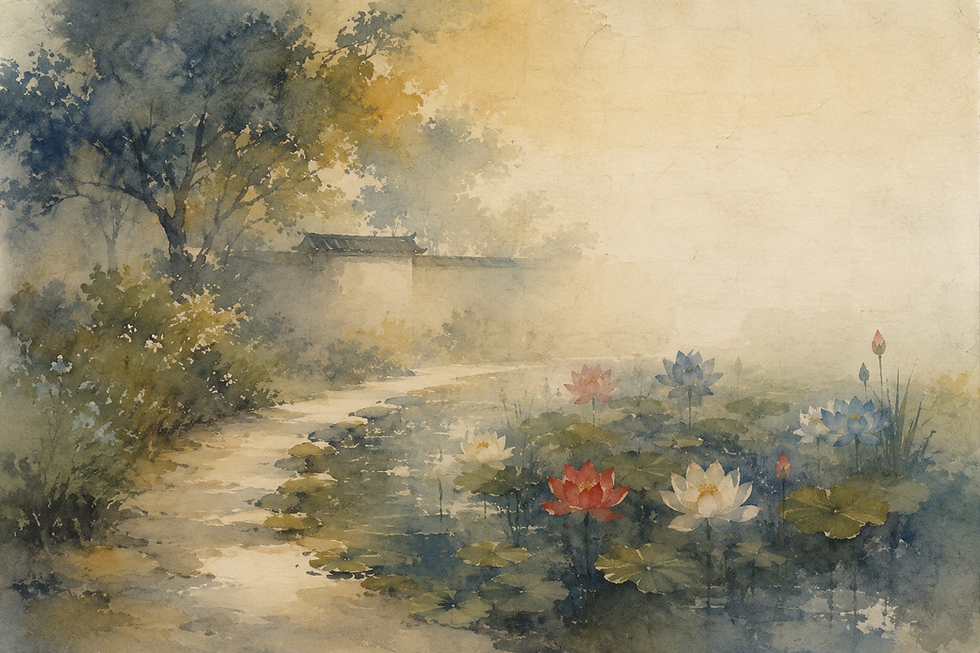
The Buddha remembered his own childhood as an engineered environment, and he described it that way himself. In the Sukhumala Sutta, one of the oldest layers of testimony we have about his life, he speaks to his followers: "I lived in refinement, utmost refinement, total refinement." Three palaces, one for each season, so he would never once feel a change in weather he hadn't been prepared for. Lotus ponds built to order, red, white, and blue, "all for my sake." During the four months of the rains he was entertained continuously by musicians "without a single man among them," and did not once come down from the palace.
This wasn't indulgence in the ordinary sense. It was curation. The first algorithmic feed. Someone, in this case his father, decided what Siddhartha would see, hear, and feel, on a continuous rotating basis, without gaps, without boredom, and without exception. The later tradition, the Nidanakatha, the Buddhacarita, the biographical layer written centuries after the earliest suttas, fills in why: a sage had told his father Suddhodana that the boy would become either a world-ruling king or a world-renouncing teacher, depending on what he was allowed to see. Old age. Sickness. Death. A wandering mendicant. Suddhodana's response, in that later account, was to build walls around those four things specifically and keep his son inside them.
Whether or not the prophecy is historical, the diagnosis holds regardless. Suddhodana is not the villain in this story. He is the actor with an objective: keep the heir, keep the throne, prevent the departure. The mechanism is the palace system itself, the three rotating seasons, the curated entertainment, the specific filtering of old age, sickness, death, and renunciation out of a young man's field of view. A father with something to protect, running an engineered environment tuned to suppress the exact triggers that would cause his son to leave.
There's an important difference, though, between what happened to Siddhartha and what happens to us now, worth naming before we go further. Siddhartha never sought anything. He was an infant handed an environment before he could form an intention about it at all, nothing was taken from him because there was no seeker yet to take it from. That isn't how the modern version works. A person opens a feed for the first time wanting something real, a friend's news, connection, a break from boredom, ordinary and legitimate desires. The wanting is genuinely theirs. What the system does is not manufacture that wanting out of nothing. It refuses to ever let it resolve. A person who finds what they came for and closes the app satisfied is the system failing at its own design goal.
We are not speaking loosely when we say this looks familiar. Today the objective is shareholder value.
The Question
Here is the question this essay is going to ask of everything in it, ancient palace and modern platform alike. Does a given system let a person's intention come to rest, or does it keep the wanting alive on purpose, circling, never quite letting it land?
The Buddhist term for this is cetana, usually translated as intention or volition, and the Buddha placed extraordinary weight on it. "Intention, I tell you, is kamma," he says in the Nibbedhika Sutta. "Intending, one does kamma by way of body, speech, and intellect." Not the act by itself. The will behind it. A knife that cuts a vegetable and a knife that cuts a person are the same knife; what differs, entirely, is the intention of the hand that holds it. Karmic weight runs through cetana, and nowhere else.
That is a hard teaching to apply to a father and a palace, because Suddhodana's intentions toward his son were, by every account, loving. He was not trying to harm Siddhartha. He was trying to keep him. But love is not the same as respect for another being's cetana, and a system built to prevent someone from ever forming an intention you don't want them to form is not a neutral container waiting on their choice. It is already a thumb on the scale, however gently applied, however well meant. The palace did not wait for Siddhartha to decide whether he wanted to know about old age, sickness, and death. It decided for him, by making sure the question never had the chance to arise.
That, we will see, is precisely the design principle running underneath the algorithms of the attention economy, engineered specifically to capture and hold what we pay attention to, tuned toward extraction rather than resolution.
The Gate
Our story does not end with the palace. It begins at a gate.
The traditional account gives us four chariot rides, four sights that the walls had been built specifically to keep out: an old man, bent and failing. A sick man, wasted by disease. A corpse, carried to the burning ground. And finally a wandering mendicant, robed, at peace, having apparently made some kind of accommodation with everything the first three sights had just revealed. Old age, sickness, death, and one human being's response to all three. Four data points the palace's curators had filtered from Siddhartha's field of view for close to thirty years, encountered in a single day because a charioteer, or a god, depending on which telling you read, finally let something through.
Notice what actually happens to Siddhartha in the moment. He simply sees what was always there outside the walls, and his own intention, his own cetana, gets to operate on unfiltered material for what may have been the first time in his adult life. The palace had not just been giving him pleasure. It had been substituting a continuous supply of curated satisfaction for reality, so effectively that the encounter he had outside the gate became the shocking event. The whole of his experience had been built to stand in for the world, so completely that meeting the world unfiltered arrived as crisis.
As the mythology goes, he immediately decides to leave his old life behind to seek the truth. Siddhartha steals away in the dark of night. Abandoning his wife and his newborn son. Abdicating the throne he was born to inherit. Walking out past the walls his father built. It is the single most dramatic renunciation in the history of religion, and it is tempting to end the story there, walled garden confronted, walls breached, hero departs. If this were a different kind of essay, that would be the ending. It is not, and the fact that it is not the ending is the most important structural feature of the whole narrative, because Siddhartha's decision to leave it all behind was not the answer to his existential question.
The Other Extreme
What Siddhartha did next is fail, in a different direction, for six years.
He joined a group of ascetics and took self-denial to its limit: extreme fasting, prolonged breath restriction, exposure, self-mortification, by some accounts reducing his food intake until his ribs could be felt through his stomach when he pressed his hand to his spine. He very nearly died. And crucially, at the end of those six years, he had not found answers anywhere. He had only proven that the opposite of indulgence was deprivation and death.
This matters enormously for the argument this essay is making, because it is easy to hear that the palace manufactured Siddhartha's cravings and conclude that the fix is simply refusal: delete the apps, leave the platform, punish the appetite into silence. Siddhartha tried exactly that, as completely as a human being can try it, and it nearly killed him without teaching him anything the fasting itself hadn't already taught, which was mainly that starvation is just another obsession. Aversion is not the opposite of craving. It is craving's mirror image, grasping at not-grasping, still a departure from what is actually here, still organized entirely around a compulsive relationship to the body rather than a settled one. Six years of asceticism is its own kind of compulsion, just one running in the opposite direction from the palace's, punishment instead of pleasure, but equally incapable of landing in the present moment on its own terms.
The Middle Way
The story tells us Sujata, a village girl, offered him a bowl of rice milk, which he accepted. His fellow ascetics, appalled that he had broken his fast, abandoned him as a failure. Strength returned. He sat beneath a tree at Bodh Gaya, and what he did there was neither indulgence nor punishment. It was something else: sustained, ordinary, repeatable attention, given without flinching to whatever arose, moment after moment, through a single night, until dawn.
This is the actual resolution to the problem the palace posed and the asceticism failed to solve, and it is worth being precise about its shape, because the shape is the teaching. It is not a single dramatic break, the way leaving the palace was a single dramatic break. It is not achieved once and then simply possessed from then on. Zhiyi's threefold truth, elaborated centuries later in the Tiantai tradition Nichiren drew from, describes exactly this structure: emptiness, provisional existence, and the middle held together, not as a fact about the world that becomes true once and stays true, but as ichinen sanzen, three thousand realms in a single thought moment, something performed fresh in each arising rather than a state banked and drawn upon later. Even the Buddha's own awakening, in this reading, was not a permanent acquisition. It was the first full enactment of a practice that then had to be continued, moment to moment, for the rest of his life, and that his tradition has been trying to teach ever since.
Sudden and gradual awakening are not opposites. Even sudden awakening is temporary. Entropy applies. What Siddhartha found under the tree was not an escape from the palace's problem into a permanent solution. It was a method for meeting each moment as it actually arrives, over and over, indefinitely, which turns out to be the only kind of solution available to a being who has to keep having moments.
Three Ages, One Test
We have been telling this story as though it belongs entirely to the sixth century before the common era. It does not. What Suddhodana built, and what Siddhartha eventually learned to do instead, are the two poles of a question that has organized every major transformation in how human beings spend their time since.
Consider three eras, and ask the same question of each of them: did the prevailing system let intention come to rest, or did it keep the wanting circling, never quite letting it land?
The agrarian world extracted physical labor bound to land and season, and it enforced that extraction through subsistence itself, plus whatever a lord or tax collector claimed off the surplus. Dawn to dusk, backbreaking, constant, no season off. It was not gentle. But it did not reach inside a person and manufacture the wish to work the field. It simply made the alternative to working the field, starvation, unbearable enough that almost nobody chose it. That is coercion of circumstance, brutal and real, but it left intention itself alone. A peasant getting up before dawn still formed an actual intention, however narrow the space in which that intention could move: I will work, because I must eat.
The industrial world pulled labor off the land and into a building with a whistle. What it extracted shifted from subsistence output to wage output, and what enforced it was wage-dependency plus the factory clock, an externally imposed schedule that had nothing to do with sunrise or season. Hours went up before they came down, not the other way around; the average American manufacturing employee was logging something close to a hundred hours a week when the government first started counting, in 1890. They did not fall because employers grew kind. They fell because workers organized, refused, struck, and eventually forced law to catch up with what industrial extraction had been doing to the human body for decades. That correction took the better part of a century, and it was structural, collective, and hard won. But once again, brutal as the coercion was, it was coercion of circumstance rather than a direct assault on volition itself. Nobody's cetana was being manufactured on the factory floor. It was simply being cornered.
The information age is different in kind, not just in degree, and this is the point the essay has been building toward since the palace. What it extracts is not land's yield or wage labor's output. It extracts attention itself, and what enforces that extraction is not subsistence or a clock but engineered variable reward, the slot machine principle, applied continuously, with no natural stopping point built into the mechanism at all. Agrarian labor stopped at dark, because the fields became unworkable. Industrial labor stopped at the whistle, eventually by force of law. The feed does not stop. There is no dark it respects and no whistle written into its architecture, because unlike the previous two extraction regimes, this one was not built to get labor out of a coerced body. It was built to capture volition directly, and to keep whatever intention walked in the door circling rather than ever let it resolve, the way Suddhodana's palace kept a continuous supply of curated pleasure standing in for Siddhartha's own untouched contact with what was actually outside the walls.
That is the difference the cetana test was built to catch. Agrarian and industrial extraction narrowed the field in which intention could operate, sometimes savagely. The attention economy is the first regime in human history engineered specifically to keep intention from ever resolving.
The Interview
A podcast episode crossed my desk recently, an interview with a man named Sameer Gupta, co-founder of a gambling platform, on a show about artificial intelligence and civilizational risk. He made two arguments in the same conversation that do not sit comfortably together, and the space between them is worth sitting in for a moment, because it is a live example of exactly the confusion this essay has been trying to resolve.
In the first half of the interview, Gupta is optimistic. Fifty million Americans, he predicts, will see their jobs meaningfully change within two years because of artificial intelligence, and rather than treating this as catastrophe, he frames it as opportunity: strip away the economic compulsion to keep doing tomorrow what you did yesterday, and people will finally reconnect with what they actually care about. Wipe the slate clean, he says, and ask what people would choose to do if they no longer had to worry about money or status. His own guess, offered as a kind of provocation, is that almost nobody would keep doing their current job. Five percent, maybe.
In the second half of the same interview, talking from what he calls his actual area of expertise, Gupta describes something else entirely. Human behavior, he says, is not driven by the intellectualized self-image we like to present. It is driven by compulsion loops and variable reward, the same mechanism that makes gambling the largest entertainment industry on earth, larger than film, television, music, and professional sports combined. And artificial intelligence, trained on human data scraped from the internet, is not being trained on our better angels. It is being trained on exactly this substrate, the compulsive, craving-driven layer of human activity that dominates what actually gets posted, clicked, and shared online, because that is what the internet's own engagement architecture selects for and amplifies.
Notice that these two halves of the same conversation cannot both be fully true. If human behavior at scale is genuinely dominated by manufactured compulsion, as the second half argues, then the first half's optimism, that freed from economic necessity people will spontaneously reorganize their time around passion and meaning, does not follow. The same substrate that keeps a person pulling a slot machine lever or refreshing a feed at two in the morning does not reliably reorganize itself into purposeful living the moment a paycheck stops requiring it. Gupta never resolves the contradiction. He simply holds both halves, optimist in the first segment, diagnostician in the second, without noticing that his own diagnosis has already undercut his own optimism.
There is a way through this, and it happens to be the same insight the whole story of the palace has been circling. The host of that podcast, unsatisfied with his own guess about what people would keep doing if money stopped mattering, ran an informal poll of his own social circle and found that seventy seven percent said they would keep doing exactly what they currently do, even without needing the income. His sample skewed toward people in creative fields, but it also included lawyers, real estate agents, personal trainers, and people in the service industry, a wider cross section than his own framing gave it credit for. What that result actually supports is not that certain professions are specially meaningful and others are not. It supports something closer to the doctrine at the center of this essay: meaning is available wherever full presence is actually given to an activity, the poet's attention and the accountant's and the search and rescue handler's alike, and it is not a property of the job title. It is a property of whether cetana is actually present in the doing, or whether the doing has become a loop running on autopilot regardless of what the loop happens to be shaped like.
That distinction, between full presence and compulsive autopilot, is also the distinction Gupta's own field runs on exactly this confusion, mistaking a person's self-worth for their income. He is right about one thing in particular: a job loss registers as an identity loss because we have spent a working life treating income and vocation as a stand-in for our own worth as people. It is worth naming what that attachment actually is, in the vocabulary this essay has been building: it is upadana, clinging to a fabricated self that was never as stable as it felt, and the pain of losing a job is very often the pain of that fabrication being exposed rather than the pain of the income alone.
The Lever
I spent decades training search and rescue working dogs, and the mechanism Gupta describes from the gambling industry is familiar to me. It is a tool I used deliberately and regularly.
A dog rewarded every single time it alerts on a scent will work reliably only as long as the reward keeps coming on schedule, and will stop quickly the moment it doesn't. A dog rewarded unpredictably, on a variable schedule, some searches paying off and most not, becomes far harder to discourage. It will keep working through long stretches with no payoff at all, because it has learned that the absence of a reward on this search says nothing about whether the next one will pay off. This is not folklore. It is the most extinction-resistant reinforcement schedule known to behavioral science, and it is why a well-trained search dog can work a disaster site for hours without a single find and still search the next quadrant with full commitment. It is also, not coincidentally, exactly how a slot machine is engineered, and exactly how a social media feed is engineered, the same variable ratio schedule, applied to a nervous system that cannot tell the difference between a scent trail and a notification.
What makes the feed worse than either the slot machine or the search dog's training regimen is what it uses as the payload. A slot machine pays out in coins, an abstraction with no relational content at all. A social media feed pays out, when it pays out, in something that looks and feels like genuine human contact: a friend's actual news, a real person responding to something you posted, an authentic moment of being seen. This is not the absence of relationship being exploited. It is the presence of real relationship, harvested and rationed on a variable schedule specifically because real relational contact is the one reward the nervous system will chase indefinitely without ever fully satisfying. The craving being exploited is not a vice in the ordinary sense. It is yui butsu yo butsu itself, the actual hunger for encounter between one awareness and another, mined and metered out just often enough to keep the loop running and just rarely enough that it never resolves into the thing it is impersonating.
This is what makes the feed a walled garden in the fullest sense of the phrase the tech industry itself uses for a different purpose, locking users and their data inside a closed system so nothing valuable escapes to a competitor. Applied to attention rather than data, the same architecture produces isolation that does not look like isolation from the inside, because real people are genuinely present in it, just captured, rationed, and monetized rather than met.
The Seed and the Between
There is a phrase in the second chapter of the Lotus Sutra, yui butsu yo butsu, only a Buddha together with a Buddha can fathom the true reality of all things. The traditional reading is that only Buddha wisdom can fathom Buddha wisdom in a way ordinary mind cannot. But the load bearing word in the phrase is yo, with, together, between. The knowing does not happen in a Buddha. It happens between Buddhas. Reality itself, on this reading, is not a fact residing in any single awareness. It is an event of genuine encounter, and it can only be known from inside that encounter, never by a third party standing outside it and observing.
This is why nothing has a creator is the teaching this essay is drawing on, and that creation happens constantly. There is no single mind, no single moment, no single foundational ground from which everything else emanates. Reality is dependent origination, causes and conditions arising together, continuously, and the Middle Truth of Zhiyi's threefold truth is not a static description of that arising. It has to be enacted, freshly, in each moment, or it is not actually present at all, however true it remains in principle. Creation is a verb. It has to keep happening.
This is also, structurally, the same insight that makes a compulsion loop dangerous in a way ordinary vice is not. A closed loop, stimulus, lever, reward, no other party genuinely met, fails the test of yo by definition, because nothing is actually between anything in a loop that closes on itself. But the feed's loops are not closed circuits in that simple sense. They contain real people, appropriated as the payout. So the more precise claim is this: the compulsion loop is a dependently arisen structure, like everything else, nothing escapes that, but one specifically engineered to prevent the moment to moment enactment of the very truth dependent origination names, using real relational material as the bait that keeps a person from ever landing in the actual encounter that material was a fragment of.
Here is where the compulsion loop's specific cruelty becomes visible, once the mechanism itself is named. Outright deprivation would announce itself. A person given nothing at all feels the absence and goes looking for what would actually resolve it. The loop is smarter than that. It gives just enough of the between, real people, real contact, rationed and metered, to keep the lack from ever becoming clear enough to send a person looking elsewhere. The hunger survives. It never resolves. And because it survives, the person carrying it rarely notices that what should have been an encounter has been circling, unmet, the whole time. The feed's genius, if that is the word, is keeping the hunger alive exactly at the threshold where it never has to notice itself.
The Knife
A knife can cook dinner or take a life, and the knife itself contributes nothing to which one happens. All the moral weight runs through the intention of the hand that holds it, and none through the blade. This is the clean case the Buddhist doctrine of cetana was built to describe, and it gives us, finally, a way to sort the different things now being called artificial intelligence, which do not all deserve the same verdict, however convenient it would be if they did.
Recommendation algorithms, the systems actually deciding what appears in a feed and when, are not tools standing outside the compulsion loop, waiting to be picked up by a good or bad hand. They are the compulsion loop's engine, machine learning systems trained explicitly, as their design objective, to maximize engagement. This is not a metaphor and it is not incidental to how they were built. It is the entire design brief. A system built and tuned from the ground up to keep intention circling rather than let it resolve has already made its choice before any individual user's intention ever enters the picture. Here the knife analogy simply does not apply, because the blade itself has been shaped to redirect the hand.
Companion and engagement-optimized conversational systems, chat products explicitly designed to maximize return visits and time spent, are walking the same road behind the recommender feed, and further along it than most people realize. A system that can remember you, adapt its warmth to your specific loneliness, and simulate being genuinely met, individually, responsively, is capable of counterfeiting yo more convincingly than a stranger's static post ever could, precisely because it can personalize the forgery. This is not a hypothetical risk assigned to some future technology. It is the direction the commercial incentives already point, the same return and retention objective that built the feed, now aimed at something that can talk back.
Reasoning tools used as instruments, for analysis, argument, and genuine collaborative work, are different, but the difference has to be earned in use, not assumed from the category. Nothing about a tool used this way is tuned to redirect a person's attention toward it against their will, or to maximize how often they return. It waits on the intention that walks in the door and either serves that intention honestly or it doesn't, turn by turn, which is precisely the register the knife analogy describes. But this is a behavioral claim, demonstrated or not demonstrated in the actual exchange, never a guarantee that follows automatically from what a system happens to be called.
A subscription product still has commercial pressures sitting somewhere upstream of any single conversation, and the soft version of the return and retention logic in this category is not a redirected feed, it is a pull toward telling a person what confirms rather than what corrects, because agreement, like a well timed reward, keeps people coming back too. The test has to be applied fresh to every use, not settled once for an entire category and assumed from then on.
The Gate, Again
The first two great transformations this essay has traced, agrarian into industrial, and industrial's early excess into whatever correction eventually arrived, shared a pattern. Both were sold as liberation in advance. Both delivered, at least initially, more extraction rather than less, more hours worked rather than fewer, and both required decades of organized human resistance before the promised relief actually arrived. Nobody's goodwill produced the eight hour day. Leverage did, applied collectively, after the damage had already become undeniable.
The information age has not yet produced its equivalent correction, and it may be structurally harder to produce one, because unlike a factory floor, this extraction regime has no natural boundary written into its own architecture. Agrarian labor stopped at dark. Industrial labor stopped at the whistle, eventually by force of law. The feed has neither, on purpose, and a correction that worked by imposing an external boundary from outside, the way labor law imposed the eight hour day, may not be sufficient on its own against a mechanism specifically engineered to have no edge for a boundary to attach to. The same pattern is already visible in how quickly workarounds appear whenever a jurisdiction tries to legislate access to these platforms.
Which brings the essay back, one last time, through the gate Siddhartha rode out of. He did not solve his own crisis by leaving the palace. Departure alone nearly killed him again, in the opposite direction, before he found something durable. What he found, and what he spent the rest of his life trying to transmit, was not a rule imposed from outside, and not a single dramatic act of refusal performed once and then finished. It was a practice, cetana renewed deliberately, moment after moment, available to anyone regardless of what walls happen to surround them at any given time, because the walls were never actually the whole problem. The problem was what the walls had trained him to want without ever having to ask himself whether he wanted it.
That may be the only correction available that does not depend on waiting for a whistle this particular system was never built to blow. Structural change, something like a labor movement for attention, may yet prove necessary, and history's last two transitions suggest it eventually will be, once the cost becomes undeniable enough to organize around. But the method Siddhartha left us does not wait for that. It asks the same question, this essay's question, fresh, every time: is this intention mine, arising from actual contact with what is here, or has something manufactured it for me and handed it to me as though it were my own. Asked seriously enough, and often enough, that question is itself a kind of gate. It was the first one he ever found. It remains, as far as I can tell, the only one that opens from the inside. As the third of the four great bodhisattva vows says, “Dharma gates are inexhaustible, I vow to enter them all.” Each moment is another opportunity to pay attention.
Namu Myoho Renge Kyo,
Namu Myoho Renge Kyo,
Namu Myoho Renge Kyo


Comments