Consciousness is Non-Local
- twobuddhasmain
- Sep 14, 2025
- 2 min read

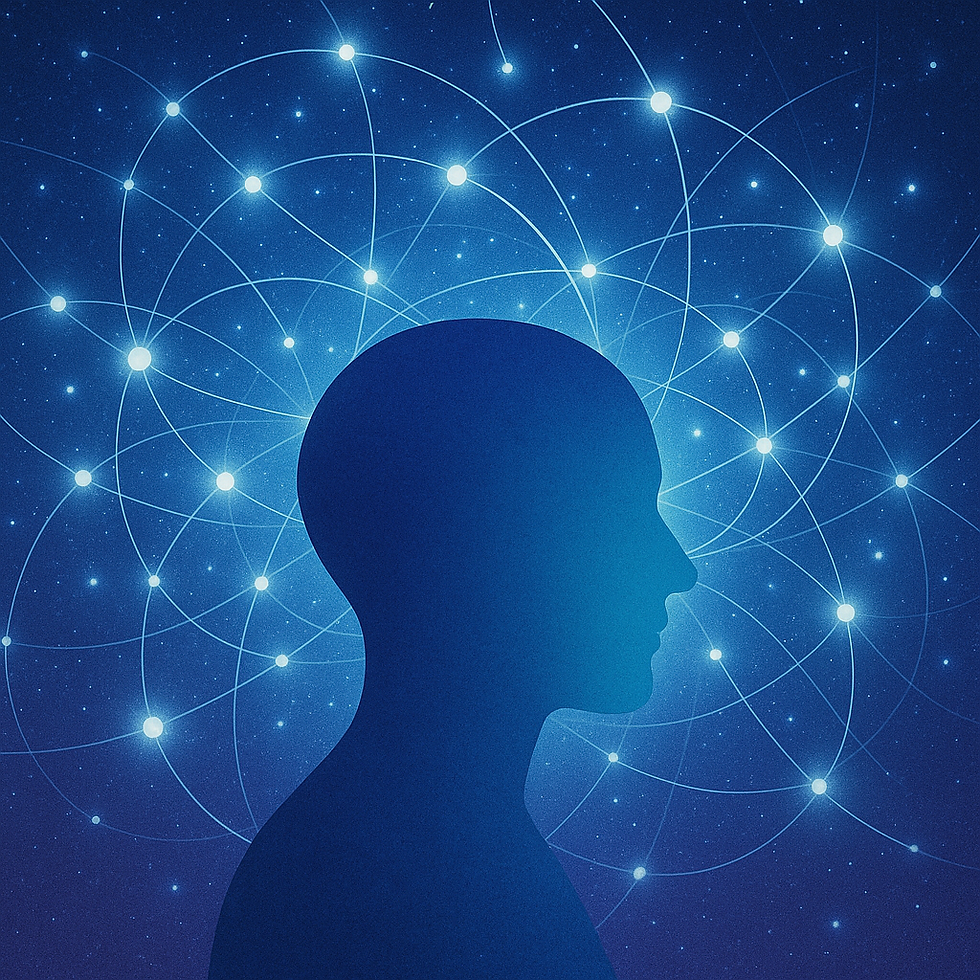
When I think about the question of whether consciousness is nonlocal, as some researchers in neuroscience and noetic studies propose, I find myself drawn back to the old debates between the Yogacara and Madhyamaka schools of Buddhism.
Contemplating the noetic theory of nonlocal consciousness, I’s reminded of the Lotus Sutra speaking across the centuries. The sutra doesn’t argue in the abstract about whether mind is local or nonlocal, it points to something deeper: that the true nature of things cannot be grasped by concepts alone. In Chapter Two, Skillful Means, it says, “Only a Buddha together with a Buddha can fathom the true reality of all dharmas.” That line has always struck me as a reminder that ultimate truth is not something the discursive mind can capture, but something revealed when awakening encounters awakening. It is relational, resonant, nonlocal in the deepest sense.
The Yogacara school’s teaching of consciousness-only begins to make sense in this light. Our experience of the world is mind-dependent, filtered through the storehouse consciousness and conditioned by past karmic seeds. This aligns with modern suggestions that consciousness is not just confined to the brain’s local neurons, but it participates in some wider field. Nagarjuna, using the wisdom of the Lotus Sutra went further, insisting that even this wider field of consciousness is empty. The very projections of mind are already Buddha-nature when seen this way:“Defilements are the same as Awakening, and Suffering is the same as Nirvana.”
Nagarjuna’s exquisite logic states us that even consciousness, even the storehouse itself, is not some permanent, absolute essence. To cling to “consciousness-only” as an ultimate truth is to miss the point. For Madhyamaka, all dharmas are empty of self-nature, neither arising nor ceasing in any ultimate way. This emptiness applies to mind just as much as to matter. Consciousness may be nonlocal, but it is also without inherent essence. It is not “something” floating free of the world, any more than matter is.
Tiantai’s Threefold Truth comes as a reconciliation, both schools - Yogacara and Madhyamaka - are right. The truth of emptiness confirms Madhyamika’s insight: all phenomena, including consciousness, are empty of intrinsic being. The truth of provisional existence affirms Yogacara’s insight: things do appear, and they appear through consciousness as dependently co-arising projections. The middle truth gathers the two together, showing that emptiness and appearance are not separate domains but one suchness. The world appears precisely because it is empty, and its emptiness is expressed in its very arising. To see this is to realize that consciousness is not bound within the skull nor floating beyond it but is the dynamic play of emptiness and appearance in every moment.
So when modern science edges toward the suggestion that consciousness may not be local, may not be reducible to neurons alone, it lends fresh weight to Yogacara’s vision. But only in conversation with Madhyamaka’s warning and the Threefold Truth’s embrace does that vision remain balanced. Otherwise, we risk either reifying consciousness as some eternal substance or collapsing it back into material reductionism. The beauty of Buddhism is that it doesn’t force a choice between mind or matter, inner or outer. It lets us rest in the paradox where emptiness and appearance, consciousness and world, are interpenetrating facets of the same luminous suchness.


Comments