Juzu Beads: The Geometry of Practice

What the Juzu Has Been Trying to Tell Us
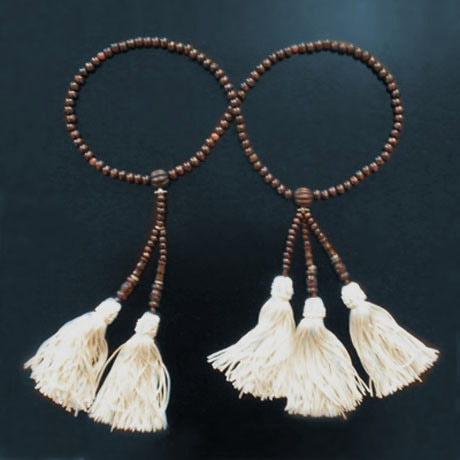
Pick up a Nichiren juzu and you are holding a symbolic universe. The 108 beads of the main loop represent the 108 defilements — the full catalog of what clouds the mind. The two large parent beads represent Shakyamuni and Taho Buddha, the dyad of the Ceremony in the Air. The tassels represent the head, arms, and legs — ourselves, present in the practice. This is the traditional account, and most of it holds up.
Nichiren Buddhism emerged from Tendai which uses a four-tassel juzu, the same arrangement Tendai and Shingon practitioners used. At some point — the exact history is murky and lost to time — Nichiren sects added a fifth tassel to visually differentiate their practice from those lineages. A reasonable move. Nichiren’s Three Great Secret Dharmas — the Gohonzon, the Daimoku, the Kaidan — represent a genuinely distinctive contribution, not merely a refinement of Tendai. A distinctive practice lineage warrants a distinctive ritual object. The fifth tassel is earned.
But then someone had to explain what the fifth tassel meant. And someone else had to explain the four. And the explanations that got passed down placed the four Bodhisattvas of the Earth in the wrong location entirely — tucked into the main loop among the defilements, easily overlooked, two small beads on each side of a circle whose primary symbolic meaning is everything that obscures awakening.
That is a strange relegation for the commissioned guardians of the Daimoku.
The confusion runs deep enough that even Nichiren Shu priests will give differing opinions what these mean. One highly respected priest identifies them as the Four Heavenly Kings. Another says they are the four Bodhisattvas of the Earth. Both are ordained. Both are sincere. They inexplicably disagree. Which is really weird given how important the four bodhisattvas of the earth are within Nichiren Buddhism.
The correct reading is that the four small beads in the main loop are called Shitenju —the Japanese term for the Four Heavenly Kings. The Bodhisattvas of the Earth are not in the main loop.
So where are they?
The Geometry of the Gohonzon
Before answering that, we need to look at the Gohonzon.
When Nichiren inscribed his calligraphic mandala, he placed the four leaders — Superior Practice (Jogyo), Boundless Practice (Muhengyo), Pure Practice (Jyogyo), and Steadfast Practice (Anryugyo) — in the uppermost register. They flank Namu Myoho Renge Kyo directly. They stand above the celestial bodhisattvas, above the gods and protectors, in the most honored position the mandala offers, alongside Shakyamuni and Taho Buddha who anchor the Ceremony in the Air.
Their placement is not decorative. It is a statement about what practice is for and who upholds it.
Shakyamuni and Taho are the anchoring dyad of Yui Butsu Yo Butsu — the mutual recognition that only happens in the yo, the between. Only between a Buddha and a Buddha. Their shared throne in the Ceremony in the Air is the visual enactment of Ichinen Sanzen, the mutual possession of the Ten Worlds, the whole holistic interconnection circle made visible. The four leaders surround this. They witness it. They are its guardians and its heralds.

That is the symbolic grammar of the Gohonzon. Now look at the tassels.
The Tassels Tell the Truth
The juzu has five tassels. The Kazutori tassel — the single counting tassel — is the Daimoku. This much the tradition agrees on. The four Deshi Dama tassels surround it.
Four tassels. One Daimoku. The four literally holding the one.
That is the geometry of the Gohonzon, enacted in the object you hold in your hands.
The Bodhisattvas of the Earth are not a footnote in the main loop. They are the four who surround and uphold the Dharma. Their whole commission in Chapters 15 through 22 of the Lotus Sutra is to receive the entrustment of the Mystic Law and carry it into the Latter Day. They emerge from beneath the earth when the Daimoku is sounded. They gather around it. They hold it.

The five tassels show you this every time you pick up your juzu. You just need the right explanation to see it.
What You Hold in Your Hands
Put it all together and the symbolic map of the juzu becomes coherent in a way the traditional account never quite managed.
The 108 beads are the defilements — the full weight of what obscures the mind. The Shitenju, the Four Heavenly Kings, stand as guardians at the four compass points of the main loop, protecting the practice circle. Shakyamuni and Taho anchor the two sides as the parent beads, the dyad of mutual recognition, the Ceremony in the Air made tangible in wood and cord.
And the five tassels: the Kazutori, the Daimoku, the living sound of Namu Myoho Renge Kyo — surrounded and upheld by the four Deshi Dama, the four leaders, Superior Practice and his companions, present wherever the Dharma is held.
The beads you count are defilements being worked through. The tassels you hold are the Bodhisattvas of the Earth holding the Dharma. The whole arc of practice is right there in the object.
You were already holding it. Now you know what you’re holding.


Comments